• Home
  • About
    • Fintech Family
  • Authorisations
    • CASP (MiCAR)
    • Buying & Selling
    • Payments & Emoney >
      • Support Material
  • Crowdfunding
  • Services
    • Regulatory Licences
    • Interim Solutions
    • Training
  • Brexit
    • Brexit Updates
  • Blogs & Insights
  • News
  • Team
  • Contact
  • Fintech Ireland
  • Client Login
  • Home
  • About
    • Fintech Family
  • Authorisations
    • CASP (MiCAR)
    • Buying & Selling
    • Payments & Emoney >
      • Support Material
  • Crowdfunding
  • Services
    • Regulatory Licences
    • Interim Solutions
    • Training
  • Brexit
    • Brexit Updates
  • Blogs & Insights
  • News
  • Team
  • Contact
  • Fintech Ireland
  • Client Login
CompliReg
  • Home
  • About
    • Fintech Family
  • Authorisations
    • CASP (MiCAR)
    • Buying & Selling
    • Payments & Emoney >
      • Support Material
  • Crowdfunding
  • Services
    • Regulatory Licences
    • Interim Solutions
    • Training
  • Brexit
    • Brexit Updates
  • Blogs & Insights
  • News
  • Team
  • Contact
  • Fintech Ireland
  • Client Login

Blogs & Insights

    Author

    Peter Oakes is an experienced anti-financial crime, fintech and board director professional.

    He has served in senior roles at central banks (Ireland & Saudi Arabia) and financial regulators (UK and Australia).

    Peter is an experienced board director of regulated finserv & fintech firms and advisor to regtech firms.

    Archives

    January 2025
    December 2024
    July 2024
    May 2024
    April 2024
    February 2024
    October 2023
    July 2023
    June 2023
    May 2023
    April 2023
    February 2023
    January 2023
    November 2022
    October 2022
    September 2022
    August 2022
    July 2022
    June 2022
    May 2022
    April 2022
    March 2022
    December 2021
    November 2021
    September 2021
    July 2021
    June 2021
    May 2021
    April 2021
    February 2021
    December 2020
    November 2020
    October 2020
    September 2020
    August 2020
    July 2020
    June 2020
    May 2020
    February 2020
    January 2020
    December 2019
    June 2019

    Categories

    All
    ACAMS
    AIB
    AML
    Anti Money Laundering
    Anti-money Laundering
    AUSTRAC
    Authorisation
    Bank Of England
    Bank Of Ireland
    Bank Of Lithuania
    BIS Innovation Hub
    Bitcoin
    Blockchain
    Brexit
    Capital Requirements
    CBDC
    Central Bank Of Ireland
    Chambers And Partners
    Compliance
    Consultation
    COVID-19
    Crypto
    CRYPTOASSETS
    Culture
    Cybercrime
    Cyberfraud
    Cyberrisk
    Cyprus
    Data Protection
    Dear CEO Letter
    Digital Assets
    Digital Currencies
    Digital Euro
    EBS
    ECB
    EML
    Emoney
    Enforcement
    Equivalence
    ESMA
    FCA
    Financial Conduct Authority
    Financial Crime
    Finolita Unio
    FinTech
    FintechUK.com
    Fitness & Probity
    FIU Ireland
    FTX
    GDPR
    Individual Accountability
    Insider Dealing
    Insider Trading
    KBC Bank
    Law
    Lithuania
    Map
    MiCA
    MiFID
    Moneycorp
    Money Laundering
    Payments
    Payments System Regulator
    RegTech
    Risk Management
    Sam Bankman-Freid
    Sandbox
    SARs
    SEAR
    Square
    STRs
    Terrorist Financing
    Tracker Mortgage
    Tracker Mortgages
    VASP
    Virtual Assets
    Westpac
    Wirecard

Back to Blog

Tullett Prebon, MoonPay and HiddenRoad join Fintech UK's Who's Who of UK Registered Cryptoasset Map Version 6.0  Saturday 1st April 2023

1/4/2023

 
Picture
Fintech UK is looking to partner with registered / regulated (or soon to be) cryptoasset firms on building out a cryptoasset section on our website.  If you are senior executive at a UK registered cryptoasset firm, please contact us here to discuss the proposed project.  Also happy to hear from senior executives at businesses which support crypto firms to support the project. See our CRYPTO page for more information

If you are are crypto firm seeking regulatory advice or director services, please contact CompliReg for assistance at the details appearing here and check out its VASP registration and other authorisation services here.

Hope you like the Map (Version 6.0)!
Welcome to the version 6.0 of Fintech UK's and CompliReg's (a leading provider of fintech consulting services to crypto asset firms) UK FCA registered Cryptoasset Firms Map.

There are now 41 registered Cryptoasset firms appearing on the Financial Conduct Authority's (FCA) website as at Saturday 31st December 2022.  Joining Version 6.0 are three new entrants - Tullett Preborn (Europe) Ltd, MoonPay (UK) Ltd and Hidden Road Partners CIV UK Ltd.    The FCA register records their registrations effective 21st November, 9th December and 20 December 2022, respectively.

As we continue to Map registered Cryptoasset firms, expect to see certain logos appear more than once as several brands will be registering several Cryptoasset firms for different purposes, such as - for example - services for (1) trading and (2) custody. An example of this is in fact Zodia.  While Zodia Markets (UK) Limited was registered on 27 July 2022, its affiliate Zodia Custody Limited was registered effective 15 July 2021.

At the time we released Version 1, there were 218 (thereabouts) unregistered cryptoasset business listed on the UK FCA's website that appear, to the FCA, to be carrying on cryptoasset activity, that are not registered with the FCA for anti-money laundering purposes.  As of today (01 April 2023), that number has decreased to 82.  


The firms thus far registered by the FCA include:

2020: Archax Ltd, Gemini Europe Ltd, Gemini Europe Services Ltd, Ziglu Limited, Digivault Limited, 

2021: Fibermode Limited, Zodia Custody Limited, Ramp Swaps Limited, Solidi Ltd, Coinpass Limited, CoinJar UK Limited, Trustology Limited, Commercial Rapid Payment Technologies Limited, Iconomi Ltd, Skrill Limited, Paysafe Financial Services Limited, Crypto Facilities Ltd, Fidelity Digital Assets LTD, Payward Limited, Galaxy Digital UK Limited, BABB Platform Ltd, BCP Technologies Limited, Zumo Financial Services Limited, Baanx.com Ltd, Bottlepay Ltd, Genesis Custody Limited, Altalix Ltd, 

2022: X Capital Group Limited, Enigma Securities Ltd, Light Technology Limited, eToro (UK) Ltd, Uphold Europe Limited, Wintermute Trading LTD, Rubicon Digital UK Limited, DRW Global Markets Ltd,  Zodia Markets (UK) Limited, Foris DAX UK Ltd (aka Crypto.com), Revolut Ltd*, 
Tullett Preborn (Europe) Ltd, MoonPay (UK) Ltd and Hidden Road Partners CIV UK Ltd.

* Revolut group still has not achieved its much talked about ambition of securing a bank authorisation in the UK.  ​

We are looking forward to seeing how many more will be registered during 2023.  Thus far, there have been no registrations in 2023.

The post accompanying Version 6 appears at:
  • ​CompliReg: https://complireg.com/blogs--insights/tullett-prebon-moonpay-and-hiddenroad-join-fintech-uks-whos-who-of-uk-registered-cryptoasset-map-version-60-saturday-1st-april-2023​
  • Linkedin: https://www.linkedin.com/posts/peteroakes_cryptoasset-cryptomap-cryptofirms-activity-7048281954894368768-VbNC?utm_source=share&utm_medium=member_desktop

​
Further Reading:

Version 1 of the Map and the Blog of 20 December 2021 - located here

Version 2 of the Map and the Blog of 18 July 2022 - located here 

Version 3 of the Map and the Blog of 28 July 2022 - located here

Version 4 of the Map and the Blog of 20 September 2022 - located here

Version 5 of the Map and the Blog of 26 September 2022 - located here

List of ​Unregistered Cryptoasset Businesses as at today - located here
0 Comments
Read More
Back to Blog

UK Registered Cryptoasset Map Version 4.0 Tuesday 16th August 2022

16/8/2022

 
Picture
CompliReg, your first choice for regualtory authorisations, licences and registrations is proud to support Fintech UK and its endeavours to Map the FCA registered cryptoasset market in the UK.
Fintech UK is looking to partner with registered / regulated (or soon to be) cryptoasset firms on building out a cryptoasset section on our website.  If you are senior executive at a UK registered cryptoasset firm, please contact us here to discuss the proposed project.  Also happy to hear from senior executives at businesses which support crypto firms to support the project. See our CRYPTO page for more information

If you are are crypto firm seeking regulatory advice or director services, please contact CompliReg for assistance at the details appearing here and check out its VASP registration and other authorisation services here.

Hope you like the Map (Version 4.0)!
Welcome to the second edition (version 4.0) of Fintech UK's and CompliReg's (a leading provider of fintech consulting services to crypto asset firms) UK FCA registered Cryptoasset Firms Map.

There are now 37 registered Cryptoasset firms appearing on the Financial Conduct Authority's (FCA) website as at Tuesday 16th August 2022.  Welcome to Crypto.com.   The FCA register records Foris DAX UK LTD (aka Crypto.com) registration effective 16th August 2022.  

At the time Version 1.0 was released there were 218 (thereabouts) unregistered cryptoasset business listed on the UK FCA's website that appear, to the FCA, to be carrying on cryptoasset activity, that are not registered with the FCA for anti-money laundering purposes.  As of today (20 September 2022), that number has decreased by one to 247.  On both 18th and 28th July 2022 the figure was 248. 

Read more at Fintech UK on facts and figures about the cryptoasset firms appearing on Version 4.0.

0 Comments
Read More
Back to Blog

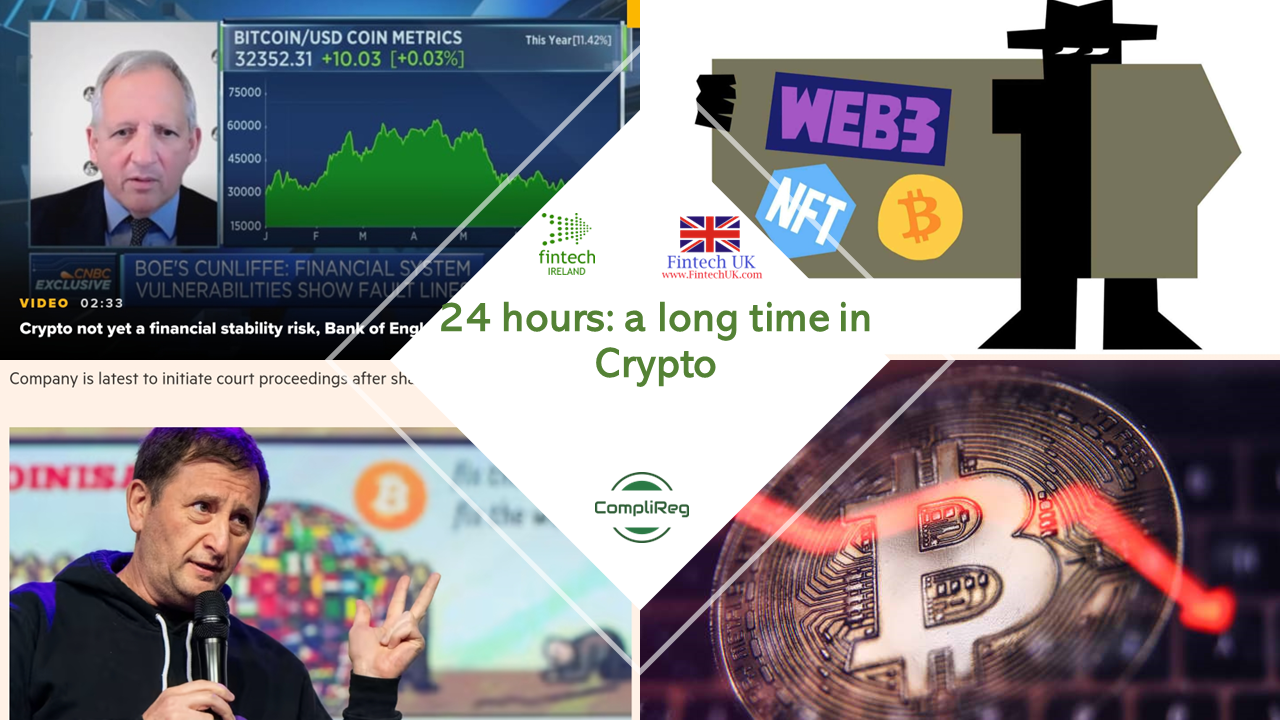
Crypto firm Celsius Network files for Bankruptcy; meanwhile Central Bank says tech can't save us from risk

14/7/2022

 
Picture
Any surprises here?

In the same week that Bank of England, Deputy Governor for Financial Stability (John Cunliffe) said “Financial assets with no intrinsic value … are only worth what the next buyer will pay. They are therefore inherently volatile, very vulnerable to sentiment and prone to collapse,” we learn of yet another crypto firm filing for bankruptcy and the protection it affords.. 

Put another way: technology can’t remove all financial risks. 

Celsius Network, one of the world’s largest cryptocurrency lenders, filed for bankruptcy, following a wave of digital asset companies that have frozen assets and entered restructuring amid a sharp sell-off in cryptocurrencies thus far in 2022. 

Its business model was simple old-fashioned lending. Celsius took in customer deposits and lent out the funds at higher interest rates, making a profit from the difference. There is nothing innovative here, just as there is nothing innovative about Buy-Now-Pay-Later (laybuy on an app). In both cases it is simply technology putting a new spin on an old play. 

To lure investors, Celsius offered high-interest rates and claimed its risks were small. Yet according to a Financial Times investigation, Celsius took on increased financial risks in recent months as demand for loans from institutional investors waned. This is classic behaviour by financial firms when they finally see the writing on the wall. 

What do we learn from the filing? 

  • Chapter 11 bankruptcy filing comes roughly a month after it froze customer assets, trapping billions of dollars across more than a million accounts.
  • it listed between $1bn - $10bn in assets, the same amount in liabilities
  •  100,000 creditors
  • filing will be an “opportunity to stabilise its business” and undergo a restructuring “that maximises value for all stakeholders”.
  • had it not restricted withdrawals there would have been a run on its deposits operating on a first come, first served basis, leaving others with illiquid and less certain claims. 

A rather ironic outcome of the Celsius failure is that Alvarez & Marsal, a consultancy best known for unwinding failed investment bank Lehman Brothers after the 2008 financial crisis, is Celsius’s restructuring adviser.

Cunliffe is also reported saying "Cryptocurrencies may not be “integrated enough” into the rest of the financial system to be an “immediate systemic risk,” but he suspects the boundaries between the crypto world and the traditional financial system will “increasingly become blurred.”.

Now Celsius is not alone. We have also seen the implosion of a highly leveraged crypto hedge fund, Three Arrows Capital, which filed for bankruptcy in July 2022 too. Crypto lender Voyager Digital also filed for bankruptcy recently while other companies narrowly averted a similar fate by taking in emergency cash at fire sale prices.  BlockFi agreed to a rescue deal with crypto trading exchange FTX on July 1 that valued the lender at up to $240mn, far below an earlier valuation of $4bn.

What about investors?

I don't mean the customers but the backers. Celsius’s failure is poised to leave venture capital backers nursing large losses. In late 2021, it raised $750mn from WestCap and Quebec-based pension fund Caisse de dépôt et placement du Québec at a valuation of more than $3bn. Ouch - especially for current and future retirees of the pension fund. Did they sign up their money for such illiquid investments?

Further Reading:
  • https://www.ft.com/content/8d6dee7d-2cc9-4663-a0a2-e469686baca5
  • ​https://www.cnbc.com/2022/07/13/tech-cant-remove-all-financial-risks-crypto-regulation-needed-boe-.html
0 Comments
Read More
Back to Blog

UK Registered Cryptoasset Map by Fintech UK & CompliReg V1.0

20/12/2021

 
Picture
Click image for larger picture

UK Registered Cryptoasset Map Version 1.0
Monday 20th December 2021

​ 
Welcome to the first edition (version 1) of Fintech UK's and CompliReg's (a leader provider of fintech consulting services to crypto asset firms) registered Cryptoasset Firms.

There are 27 UK registered Cryptoasset firms appearing on the UK's Financial Conduct Authority's (FCA) website as at Monday 20th December 2021.

The first of these firms were registered in 2020.  According to the UK FCA's records, the first registered Cryptoasset firm was Archax on 18 August 2020.  The most recent to be registered is Altalix (today!).  While four (4) firms were registered in 2020, 2021 has seen a flurry of activity and especially in the last quarter of 2021 when 16 firms (so far) received their Cryptoasset registration from the FCA - that is whopping 60% of the total pool of registered firms.  We are looking forward to seeing how many more will be registered before the end of the year.

As we continue to Map registered Cryptoasset firms, expect to see certain logos appear more than once as several brands will be registering several Cryptoasset firms for different purposes, such as - for example - services for (1) trading and (2) custody. 

According to other records at the FCA, there are 37 firms Cryptoasset firms with Temporary Registration.  Following a quick look through that list, it seems that some of those firms may now appear on the list of registered Cryptoasset firms - so the FCA may need to revisit both lists to check there is no double counting. 

Worryingly, there are 218 (thereabouts) unregistered cryptoasset business listed on the UK FCA's website that appear, to the FCA, to be carrying on cryptoasset activity, that are not registered with the FCA for anti-money laundering purposes.  And that is not a complete list of all unregistered cryptoasset businesses operating in the UK.

Fintech UK is looking to partner with registered / regulated (or soon to be) cryptoasset firms on building out a cryptoasset section on our website.  If you are senior executive at a UK registered cryptoasset firm, please contact us at the details here to discuss the proposed project.  Also happy to hear from senior executives at business which support crypto firms on the proposed project. Note that a search on the words "Fintech UK" on google returns our website as the #1 or #2 organic search result.  A compelling reason to partner with us.

If you are are crypto firm seeking regulatory advice or director services, please contact CompliReg for assistance at the details appearing here and check out its VASP registration and other authorisation services here.

Hope you like the Map!

This post also appears at:
  • ​https://fintechuk.com/news/uk-registered-cryptoasset-map-by-fintech-uk-complireg-v10​
  • https://www.linkedin.com/posts/peteroakes_cryptoasset-cryptoasset-moneylaundering-activity-6878800276321554433-SZpd 
0 Comments
Read More
Back to Blog

Multi-CBDC prototype shows potential for reducing costs and speeding up cross-border payments (BIS)

28/9/2021

 
Picture
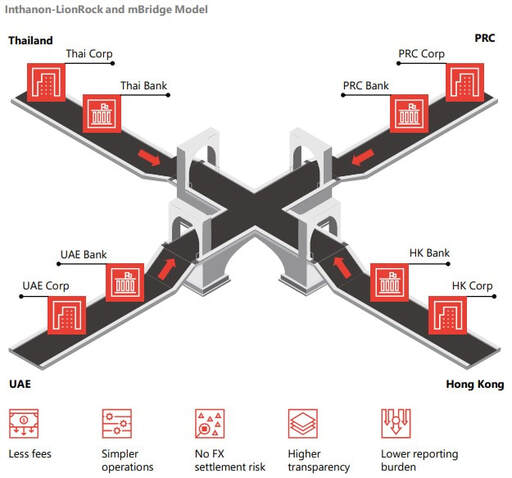
Big news today - well big news if you are interested in central banking and digital currencies - with release of the #mBridge project report on the Multi-CBDC prototype which the Bank for International Settlements says has potential for reducing costs and speeding up cross-border payments.

In summary, the mBridge kicked off as an initial experimentation from the Hong Kong and Thailand central banks. The Bank of Thailand and the Hong Kong Monetary Authority (HKMA) were joined by the Digital Currency Institute of the People's Bank of China and the Central Bank of The UAE.

The BIS Innovation Hub found the platform to be an alternative to complexities and inefficiencies of the correspondent banking system and an enabler for the joining up national digital currencies in common interoperable platforms - all performed on a 'clean slate' - an attractive proposition of technology for central banks.

In the words of Benoît Cœuré, Head of the BIS Innovation Hub "The prototype is part of our efforts to design CBDC technology. The project includes experimenting with use cases and trials, balanced with analysis of governance, policy and legal considerations with a focus on cross-border use."

The report is about a prototype of multiple Central Bank Digital Currencies (known as 'mCBDCs') developed by the BIS Innovation Hub and the four central banks.  The report finds demonstrable evidence for the potential of using digital currencies and distributed ledger technology (DLT) to deliver real-time, cheaper and safer cross-border payments and settlements under the mBridge project.
​

The common prototype platform for mCBDC settlements was able to complete international transfers and foreign exchange operations in seconds, as opposed to the several days normally required for any transaction to be completed using the existing network of commercial banks and operate in a 24/7 basis. The cost of such operations to users can also be reduced by up to half, according to the report.

Read more here:


  • ​Inthonon-LionRock to mBridge (Building a multi CBDC platform for international payments) - September 2021 
  • BIS Press Release
  • m-CBDC Project Page 
0 Comments
Read More
Back to Blog

Ireland's Finance Minister, Paschal Donohue, Speech on blockchain, crypto, fintech & innovation

24/5/2021

 
Picture
A few short interesting extracts from a speech by Minister of Finance Paschal Donohoe to Blockchain Ireland audience yesterday (24 May 2021), covering fintech, payments, blockchain and crypto.

Download the speech in PDF here 

  • "We have a track record in this country for building globally recognised #payment companies and innovative financial services businesses.
  • ​The necessity to transact a payment online forced many to implicitly “trust” in the process, without considering who the company offering such services is or what consumer protection safeguards are in place if something goes wrong.
  • #Blockchain is also enabling innovative approaches to educational credentialing in the Irish banking sector.
  • Equally, I recognise that the blockchain technology that underpins these [#crypto] currencies is being a catalyst for innovation in the financial services sector, particularly payments and capital markets.
  • As Minister for Finance, I’m conscious that investing in #cryptocurrencies continues to involve risks and that there must be adequate regulation to protect consumers in this regard.
  • ... there are 12 educational institutions across Ireland that are supporting and researching blockchain, whether that is in the form of ongoing research, study programmes or partnerships with other companies."


Full speech: Speech to Blockchain Ireland Week 2021 (Department of Finance)


Published on 24 May 2021
Last updated on 24 May 2021

 From Department of Finance 
Published on 24 May 2021
Last updated on 24 May 2021
 
Check Against Delivery

Good morning everyone.
I am delighted to be speaking to you today, albeit virtually, as part of Blockchain Ireland Week.

First of all, I would like to acknowledge the commitment of Dave Feenan to blockchain; accepting the role as the new Chair of Blockchain Ireland, a challenge that few could have met.

I would also like to acknowledge the tenacity and perseverance of Lory Kehoe, being one of the original founders of Blockchain Ireland, over 5 years ago.

Thank you also Toomas Ilves for sharing your experience in the digitalisation of your country, and your expert understanding of blockchain technology.

An inspiration for us all here, as this week we explore how we can create our present, and our future, working with this technology.

It is hard to believe it is two years ago since I had the opportunity to meet many of you personally at the Iveagh Garden hotel.

A lot has changed since, even the price of Bitcoin. Or should I say Dogecoin?

Advances in the sector
Blockchain Ireland Week is taking place at a crucial moment. The last year has been extremely difficult for everyone and the impact of Covid19 on our economy and society has been immense.
Now, as our country begins to re-open and we continue to accelerate the vaccination programme, there is a sense of collective relief; we can allow ourselves to look forward more positively.

Necessity is the mother of invention. You could say, necessity is the mother if innovation.

And this is the moment to dare conceive new business models, engage with disruptive technologies and challenge ourselves to change and adapt.

Because we need to change: as citizens, as customers, as businesses. We have all felt the need to adapt to the extreme circumstances of the pandemic.

And we must continue to adjust; not to survive, but to thrive.

The series of events that you, Blockchain Ireland, have scheduled for this week, offer an ample opportunity to learn more and explore how blockchain technology can improve our business, and our lives.

Not only in Ireland, but within the EU, and globally.

I wished I had the time to attend most of the events lined up for this week: the breadth and depth of topics being discussed is a testament to the leadership of Blockchain Ireland.

International speakers from Africa, Asia, Australia, Europe and the United States will share their respective views and experiences. An extended thanks to all those speakers for bringing their expertise to our shores.

From within Ireland, it’s fantastic to see how this technology is being used in initiatives such as:
– Provenance in craft-beer, food and agricultural products
– Making investing in bloodstock more affordable and transparent;
– Providing integrity and trust to health data;
– Exploring education and training choices.

Right now, I would like to share with you two thoughts that struck me as I read about Blockchain Ireland week.

The Benefits of Blockchain
First, the discussion is no longer about “What is Blockchain?”, “Blockchain vs Crypto” or “Risks and benefits of Blockchain”. To me, this is a very encouraging sign.

It demonstrates that the technology is maturing.

We are increasingly seeing more instances of how the technology can benefit the economy and society; more enterprises are funding pilots; more private sector consortia are being created; we also see mainstream adoption starting to take off.

The technology’s broad market applicability and the relevance to specific sectors is becoming clearer.
It also demonstrates that in Ireland we are keeping abreast with changes in the technology.

We have moved from 50 companies in Ireland working with blockchain back in May 2019 (when I last spoke to you), to almost 100 today: a sure sign that the Blockchain sector in Ireland is becoming more embedded in our ecosystem.

My question for you all is: is that enough though? Could we do more? Could we do better? If so, what do we need to do?

One of Ireland’s strengths is our ability to innovate and adapt to emerging trends across finance and technology and I have spoken before about the importance of nurturing Ireland’s knowledge economy.
As a Government, we have tried to ensure that Ireland is prepared to take the advantages of technological opportunities though a number of interconnected initiatives. These objectives underpinned the Government’s Future Jobs Ireland strategy.

Our vision, as set out in the Ireland for Finance Strategy to 2025, is for Ireland to remain internationally competitive and a top-tier location of choice for specialist IFS.

We have a track record in this country for building globally recognised payment companies and innovative financial services businesses.

As you will discuss this week, blockchain can transform the way in which many financial services sectors currently operate and deliver services to customers.

The digital asset sector is becoming an increasingly competitive environment, while creating challenges for existing legal and supervisory frameworks, trying to match market and client requirements.

We are actively monitoring developments in the technology and regulations globally, so that any potential policy changes will be crafted from a balanced, measured and carefully laid out review of risks and opportunities, both to consumers and to the economy.

However, the pace of development is fast and the consequences of change might be difficult to comprehend early on.

Thus, whether it is through the provision of digital assets or innovative ways of providing micro-insurance, I encourage you all to raise any concerns that would impede Ireland’s ability to remain competitive and a destination of choice for financial services.

It is also encouraging to see how applications of the technology are being explored across the spectrum of our society.

FutureNeuro, the Science Foundation Ireland Research Centre for Chronic and Rarer Neurological Diseases, is using blockchain to match sick patients to clinical trials based on their clinical and genomic data.

It received €3.9 million in funding from the recent Disruptive Technology Innovation Fund award under Project Ireland 2040.

Blockchain is also enabling innovative approaches to educational credentialing in the Irish banking sector.

Earlier this year I was delighted to mark the launch of the EdQ Platform, a collaboration of the Institute of Banking alongside Bank of Ireland, AIB, Ulster Bank and Deloitte.

This unique blockchain-based education credentialing platform for financial services is the first of its kind Ireland – and perhaps the world.

Finally, there are 12 educational institutions across Ireland that are supporting and researching blockchain, whether that is in the form of ongoing research, study programmes or partnerships with other companies. Another heartening sign that Ireland is collectively working towards strengthening its knowledge economy credentials, anchoring on blockchain technology.

To summarise, it is very inspiring to see evidence in the Irish blockchain sector that we are moving at pace with the maturity stages of the technology.

As Minister for Finance, I would add that I am very reassured to see my Department has closely followed the pace and continues to be an integral participant of the Irish Blockchain Ecosystem.

Trust in a Global Pandemic
My second thought, is inspired by the central theme of this week’s event, “Blockchain: Foundation of Trust”. The pandemic has certainly accelerated the move to transacting and living in a digital world: what might have taken 10 years has been achieved in 10 months.

We have all adapted to a large part of our lives being carried out online. However, necessity to do so may have trumped “trust”.

Perhaps the most visible example of this was people being forced to drop the use of cash and become proficient in digital payments.

The necessity to transact a payment online forced many to implicitly “trust” in the process, without considering who the company offering such services is or what consumer protection safeguards are in place if something goes wrong.

And this was the case for everyone, irrespective of age or digital proficiency. As people became more comfortable with making financial transactions online, the 24/7 availability and convenient access made the purchasing of cryptocurrencies more accessible to the public than ever.

As Minister for Finance, I’m conscious that investing in cryptocurrencies continues to involve risks and that there must be adequate regulation to protect consumers in this regard.

Equally, I recognise that the blockchain technology that underpins these currencies is being a catalyst for innovation in the financial services sector, particularly payments and capital markets.

Not only has the pandemic upended many of our constructs of a “normal” society, it has also challenged our trust in everything around us. Fake news should not be the new normal. Online scams should not be the new normal. Unverifiable scientific data should not be the new normal.

As Finance Minister, and as President of the Eurogroup, I take the issue of trust in our banking and payment system very seriously.

This is why we are closely monitoring developments into the review of a potential Digital Euro and follow the ECB’s ongoing research into Central Bank Digital Currencies.

At the same time, my Department is working with the EU Commission and the Presidency to bring forth a general agreement on the draft proposal for regulation for a Market in Crypto Assets.

Discussions are progressing at pace, particularly considering the technicality and complexity of the proposal. Why is this important?

Because I believe that clarity of the legal and regulatory perimeter applicable to cryptoassets will bring trust for consumers and companies to deliver and use such products and services, which in turn will generate trust in our governing institutions.

Conclusion
As Minister for Finance, I welcome you all to Blockchain Ireland Week and I really look forward to exploring the key outcomes of this week’s discussions. I am sure it is going to be a terrific week of events.
​
ENDS

Source: 
https://www.gov.ie/en/speech/50cac-speech-to-blockchain-ireland-week-2021/​
0 Comments
Read More
Back to Blog

Registration and regulatory requirements - Virtual Asset Service Providers in Ireland

1/5/2021

 
Picture
PictureStephen Fletcher, Consultant, CompliReg
Summary
Virtual Asset Service Providers (VASPs) operating in Ireland now need to demonstrate that they are compliant with the provisions of the 5th Money Laundering Directive (AMLD5) which recently came into effect on Friday 23rd April 2021.  

Preceding that date CompliReg, together with Fintech Ireland, hosted a webinar for VASPs, e-money and payments firms.  Details of that event here.  Given the demand from the audience, CompliReg and Fintech Ireland are hosting another Roundtable on the topic on Thursday 6th May - ROUNDTABLE: So, you want to be a Virtual Asset Service Provider?

Background
AMLD5 aims to remove the anonymity from the process of providing virtual asset based services.  This applies to any organisation which provides exchange services between fiat and virtual currencies, as well between virtual assets or custodian wallet providers; bringing them into the scope of the EU’s anti-money laundering and counter-terrorist financing (‘AML/CFT’) framework.

The 2021 Act
The Criminal Justice (Money Laundering and Terrorist Financing) (Amendment) Act 2021 (the "Act") amends the current Irish AML/CTF legislation, which started life a decade ago through the Criminal Justice (Money Laundering and Terrorist Financing) Act 2010 (as amended).

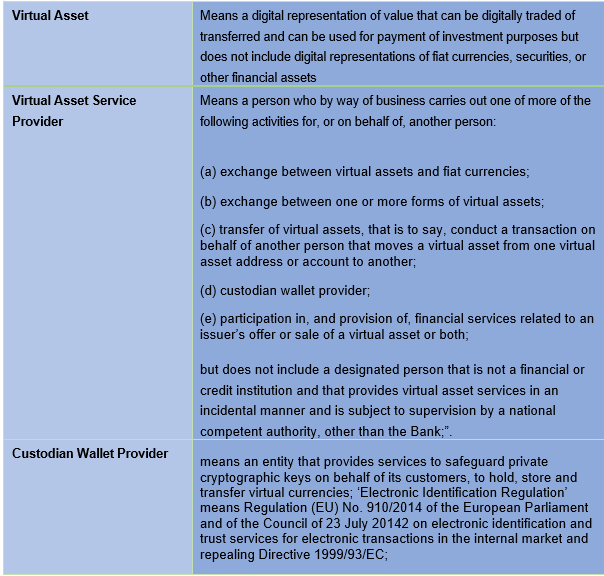
New Definitions relating to Virtual Assets
The Act contains the following new definitions:

Picture
Designated Persons
The Act brings VASPs within the meaning of "designated person" (equivalent to an "obliged entity" under EU anti-money laundering law). The relevant obligations (Relevant Obligations) of designated persons under the Irish AML regime can be summarised as follows:

  • Business Risk Assessment
Must carry out regular business risk assessments to identify and assess the risks of money laundering and terrorist financing involved in carrying on the designated person's business activities.

  • Carry out Customer Due Diligence
An obligation to carry out due diligence to verify its customer's identity.

  • Apply Business Risk Assessment when carrying out customer due diligence
Must apply the business risk assessment when deciding what level of due diligence is necessary for any given customer.  In certain circumstances, a designated person will be required to carry out enhanced due diligence.

  • Suspicious Transaction Reporting
An obligation to report to the FIU, Ireland and the Revenue Commissioners, any suspicious transaction, (or suspicious activities which may be covering up, or preparing for suspicious transactions).

  • Adopt internal policies
Must adopt internal policies, controls and procedures in relation to the designated person's business to prevent and detect the commission of money laundering and terrorist financing.

Requirement to Register
The Act requires that a person shall not carry-on business as a Virtual Asset Service Provider unless the person has successfully registered with the Central Bank of Ireland (Central Bank). This is a registration for AML/CFT purposes only. A firm currently authorised by the Central Bank under a different regime which is also acting as a Virtual Asset Service Provider will still be required to register as a VASP.

Whilst there is a three-month transitional period for VASPs to conclude the registration process the Act, which commenced operation on Friday 23rd April (commencement date), other than section 8 of the Act which commenced on Saturday 24th April, applies as of the commencement date.  This means that regardless of an existing VASP having three months to register, the VASP must comply with the Act on and from the commencement date. This means that VASPs availing of the transition period must comply on and from 23rd April with the Relevant Obligations listed above.

The Act sets out the high-level details of the registration process, and the grounds under which the Central Bank may refuse to register a VASP. These grounds include:

  • the Central Bank has reasonable grounds to be satisfied that the applicant’s principal officers or beneficial owners are not fit and proper persons to run a business of this nature;
  • the applicant has failed to satisfy the Central Bank that its business risk assessment, policies and procedures are adequate or fit for purpose;
  • the applicant has failed to satisfy the Central Bank that it has in place the resources, procedures and arrangements for the provision of the business of a virtual asset service provider and the performance of activities, taking into account the nature, scale and complexity of its business and all the obligations that the provider has to comply with as a designated person; and
  • the applicant has failed to demonstrate, that it can manage and mitigate the risks of engaging in activities that involve the use of anonymity-enhancing technologies or mechanisms and other technologies that obfuscate the identity of the sender, recipient, holder or beneficial owner of a virtual asset.

Preparation
The Central Bank’s website contains useful information for those requiring registration as a VASP, including the Criminal Justice Act* (as at commencement date), Guidelines on Fitness & Probity of Principal Officers/Beneficial Owners, and links to the AML/CFT Registration Form.  The Central Bank will not accept a registration application until the applicant has been through the pre-registration and has obtained a Central Bank Institution Number.

The Central Bank has also indicated that its current graduated approach to AML/CFT supervision will apply equally to VASPs, meaning that firms which present a higher risk of money laundering and/or terrorist financing will be subject to higher intensity and intrusive supervisory measures than those presenting a lower risk.

Next Steps
As many VASPs shall become designated persons for the first time, they should review their AML/CTF frameworks, their Relevant Obligations, legislation and guidance now.  Given that the Act has now commenced in operation, applicants should submit a Pre-Registration Information Form to the Central Bank to request a Central Bank Institution Number as soon as possible.

Being within the AML/CTF framework will surely bring benefits such as greater confidence to end-users (i.e., customers – individuals and corporates) of VASPs and hopefully, more banking partners will consider opening up their services to VASPs particularly ahead of the proposed Markets in Crypto Assets Regulation 2020/0265.

Support Available
As with any new process, it can appear complex and daunting until you have been through it a few times.  Thankfully help is at hand through CompliReg.  If you would like to setup an initial discussion to discuss your requirements, please check out our page and complete the enquiry form at  https://complireg.com/vasp.html. Stephen Fletcher or Peter Oakes will get back to you ASAP.  Our details at https://complireg.com/team.html.
 
This document (and any information accessed through links in this document) is for guidance purposes only and does not constitute legal advice.  CompliReg does not provide legal services.  Where legal services are required, CompliReg works with a select number of law firms.  If you are a law firm and wish to be considered for our panel, please contact [email protected].
Read More
Back to Blog

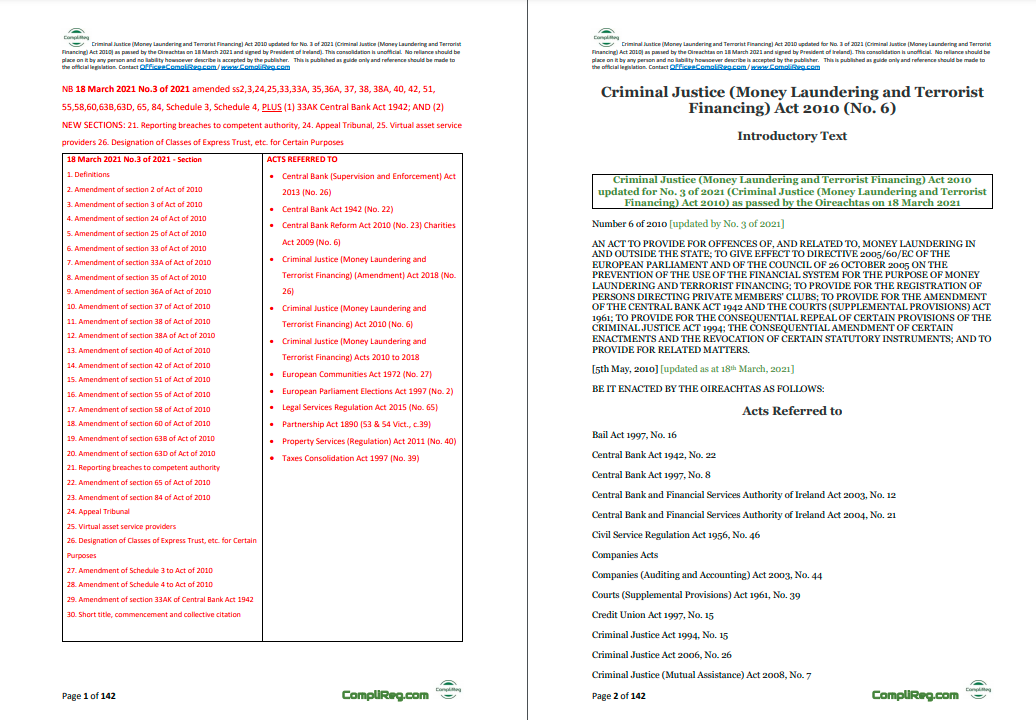
Money Laundering - Amendments to implement 5th AMLD into Ireland (18 March 2021)

16/4/2021

 
Picture
PicturePeter Oakes, Founder, Complireg
UPDATE: The law commenced operation on Friday 23rd April 2021. See Stephen Fletcher's blog of Saturday 1 May 2021 for further details

Below is my linkedin post of 16 April 2021.

​I have been asked to put a copy of the consolidation online.  We spent a lot of time preparing the consolidation and are happy to share the below slideshow.  If you would like a copy of the document in pdf which you can copy, paste and search within, please email [email protected] and we will inform of the costs and email.
 

"Some comments on the updated Irish #moneylaundering and #terroristfinancing legislation.

Linkedin Post:

What: Ireland signed into law the Criminal Justice (Money Laundering and Terrorist Financing) (Amendment) Act 2021 (the “2021 Act”). The 2021 Act (No. 3 of 2021) makes a number of changes to the 2010 Act (No. 6 of 2010)

When: 18 March 2021. Legislation passed by Oireachtas & signed into Law by the President of Ireland

Action: It’s time to update your #Compliance & #FinancialCrime Risk Frameworks, Risk Assessments, Policies, Manuals & Procedures. So what areas of the the 2010 Act impacted by the changes in March do you need to know and consider taking into account to update your compliance documents? See the comments section below where I've listed the areas from the 2010 Act impacted by the 2021 Act.

How: Contact the team at CompliReg. We are undertaking several reviews of policies, procedures and manuals in light of the recent changes made to Irish AML/CTF law. We have tracked the changes in our consolidation of the 2010 Act up until and including Act No 3 of 2021. Contact the team at [email protected] with your business contact details for a discussion of a review.

We'll be sending a copy of our up-to-date consolidated version of the 2010 Act to our clients this week."  Post at 
https://www.linkedin.com/feed/update/urn:li:activity:6788600737791303680/ 

0 Comments
Read More
Back to Blog

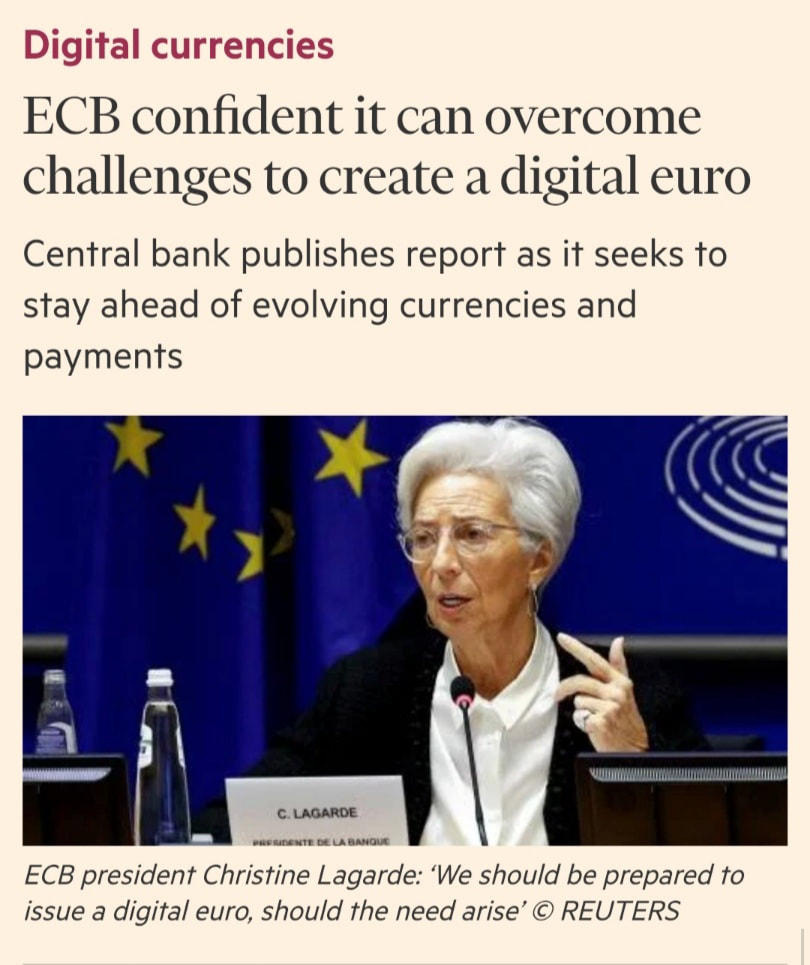
ECB confident it can create a digital euro

4/10/2020

 
Picture

ECB confident it can create a digital euro.

With ECB officials concerned that the Chinese central bank is potentially a couple of years away from launching its own digital renminbi after it conducted large-scale experiments, it has identified several scenarios that would require it to launch a digital euro.

Two scenarios are:
  1. 1) centralised: The ECB will record all digital euro transactions in the central bank’s own ledger.
  2. 2) decentralised: The ECB would set the rules for transactions to be settled and recorded by supervised intermediaries.

Either way, some serious #regtech and #suptech will be required.

Despite a 55-PAGE REPORT, the question is whether the ECB can stay ahead of the rapidly changing world of #digitalcurrencies and #payments.

Central bankers are increasingly interested in the relatively new world of digital currencies, particularly since Facebook announced a plan to launch one called Libra that has the potential to overhaul the way money works. 
 
ECB officials believe the Chinese central bank is potentially a couple of years ‘ away from launching its own digital renminbi after it conducted large-scale experiments. 

In an interesting development, Bloomberg reported on 1 October 2020, that the European Central Bank has applied to trademark the term “digital euro” as officials prepare to release an assessment of the benefits and drawbacks of creating a digital version of the currency.  The application was filed on 22 September by the ECB’s legal representatives Bock Legal, according to the website of the European Union Intellectual Property Office. An ECB spokesman confirmed the filing.

The ECB outlined potential scenarios “that would require the issuance of a digital euro”. These include higher demand for electronic payments that creates a greater need for a “risk-free digital means of payment”, as well as the potential that a cyber attack or pandemic disrupts the existing payment system and requires a digital euro to serve as a back-up.

Another scenario is a further sharp drop in cash usage that leaves some people financially excluded.

Finally, it examined the potential rapid adoption of other private or public digital currencies including those issued by foreign central banks that ‘could “threaten European financial, economic and, ultimately, political sovereignty”. The ECB said a digital euro “also poses challenges, but by following appropriate strategies in the design of the digital euro the Eurosystem can address these”.

My Linkedin Post here

Sources: 
  • https://www.ft.com/content/b6f0c233-0b35-45d1-896f-1c6599558d9b
  • https://www.bloomberg.com/news/articles/2020-10-01/ecb-applies-for-digital-euro-trademark-amid-feasibility-study 
  • https://www.ecb.europa.eu
0 Comments
Read More
© CompliReg.com   Dublin 2, Ireland  ph +353 1 639 2971 
|  www.complireg.com  |  officeATcomplireg.com [replace AT with @]

Picture
Photo from Got Credit