|
Back to Blog
  "As I write, the impact on people and businesses arising from the coronavirus is being felt across all parts of society and the economy. It is keeping many of us exceptionally busy not only assisting our clients but dealing with the impacts on our businesses too." Fintech Ireland's and CompliReg's Peter Oakes writes on the The Irish Fintech Ecosystem: Headwinds and Tailwinds (and the Making of a Global Fintech Centre) for CPA Ireland's Accountancy Plus Download the article in PDF and visit CPA Ireland's excellent resources. Continue reading below. Why would one start an article about fintech referencing Covid-19? The fact is that the virus is acting as both a headwind and tailwind for fintech companies operating from Ireland and internationally. The impact of the virus over the last month and a half on fintech has shone a spotlight on many aspects of the ecosystem that might not have otherwise come to our attention. In the current climate Ireland must also be mindful of any potential slippage of its position as a global fintech player garnered from recent years of excellent work. Let’s start with an overview of fintech. The word fintech came to prominence after the last financial crisis, particularly noticeable from 2012 onwards. Yet there were many examples of ‘financial technology’, shortened to “fintech”, existing well before the start of the last financial crisis. A number of these fintech businesses date back to the latter part of the 1980’s. Examples include the internet and phone retail bank First Direct[1] (a division of HSBC) which kicked off in 1989 and today regularly achieves high satisfaction rates in financial surveys. Ireland too served as HQ to a pioneer challenger bank, First-e[2] [6], which despite great promise was a casualty of the dot.com boom[3]. What does the Irish fintech scene look like? The consensus is that Ireland is home to somewhere between 220-250 indigenous fintech companies and that together with international fintech companies in Ireland, the number is probably around 400. It is difficult to give an exact figure if only because the word “fintech” is a broad-church. The word captures, (a) the new nonbank disruptors which focus on discrete parts of the banking value chain, e.g. payments, wealth management, treasury services and credit and lending; (b) the new breed of digital only (non-branch) challenger banks entering both retail and business banking; and (c) the incumbent banks (sometimes referred to as legacy banks) embarking - with various degrees of success – on digital transformation journeys. The recent release in April of the 2020 edition of the Fintech Ireland Map[4] identified 230 indigenous / Irish controlled fintech companies. This was an increase of 30% from the previous year. The Map is supported by both research and a survey[5]. The criteria to meet to join the Map is challenging. Entrants must be fintech companies with a proprietary product or service. Footnotes from above section - 1 https://en.wikipedia.org/wiki/First_Direct 2 https://en.wikipedia.org/wiki/First-e_Group 3 https://www.theguardian.com/money/2001/sep/08/saving.onlinebanking 4 https://fintechireland.com/fintech-ireland-map.html 5 https://fintechireland.com/fintech-survey.html 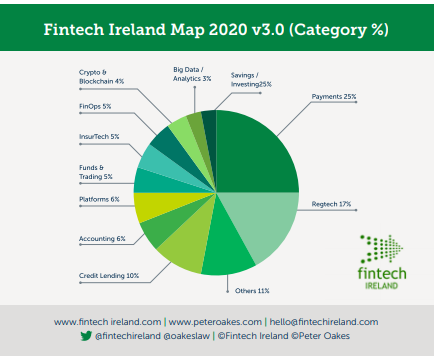 Broadly speaking the fintech companies operate across 12 categories, being Credit & Lending; Platforms; Funds & Trading; Crypto & Blockchain; FinOps (Financial Operations); InsurTech (Insurance Technology); Accounting; Payments; RegTech (Regulatory Technology); Savings / Investing; Big Data / Analytics; and Others. The number of firms in each category is shown in the diagram below. During 2019, the fintech ecosystem in Ireland, both the Republic of Ireland and Northern Ireland, continued to grow and evolve. There was strong growth in RegTech which not only increased to 39 companies but is rapidly closing in on Payments which retains its crown as the largest category for fintech companies, increasing to 58. It is no surprise that the Irish payments sector is so large given that it powers e-commerce transactions which by 2024 will double from 2010 to €3.8 billion in value. Also boding well for Ireland are two recent reports from UBS which estimate that global e-commerce will grow by 15-20% per annum over the next decade[7] from USD 3 trillion today. It is no wonder that global fintech revenue is expected to reach a staggering USD 500 billion by 2030[8]. The number of fintech firms in the Irish credit and lending sector grew in 2019, with the addition of six new entrants, to 23. This is positive news for cash strapped small-medium size enterprises. Hopefully these fintech companies will help fill the supply of liquidity which is currently in demand by cash-strapped businesses. Headwinds and Tailwinds The coronavirus crisis and its impact upon fintech is no different than the impact of the virus on other sectors of the economy. However, being a broadchurch, there are just as many fintech’s flourishing as there are floundering. FinTech’s, on average, didn’t begin 2020 with large amounts of equity. In fact, before Covid-19 the level of global investment in fintech dropped between 2018-2019 while the level of venture capital investment in Irish fintech fell off a cliff edge. In some cases, Irish fintech companies who had struck deals with international purchasers had to reduce the price to reflect, in the words of one fintech purchaser, the “economic reality” that businesses and individuals are currently facing. E-commerce companies and the fintech companies which process their payments have seen a significant fall in transaction volume and therefore revenue (processing fees) for travel related items, including airfares, hotels, holiday clothing, luggage and pre-paid travel vouchers. Whereas the fastest growing category of products and services includes – no surprises – disposable gloves, bread machines, cough & cold medicines as well as fitness equipment[9]. Thus, be wary about reading too much into e-commerce and payments processing growth, because it is not all good news. Having said that one of the most well-known e-commerce marketplaces specialising in crafted and homespun goods enjoyed a 100+% increase in share price in less than two months owing to demand for face masks! The World Bank predicts that global remittances from wealthy to poorer countries will drop by at least 20% to $445 billion. This represents a loss of a crucial financing lifeline for many vulnerable households. Much of this money is often eaten by fees by various middlemen. It is estimated that between 7% -12% of the money being transferred [10] is swallowed up by bank collection, transfer and receiving fees. Yet remittances are a vital source of income for people in developing countries. The loss of USD 10 from the value chain may mean the difference of food on the table for a family for a week in the poorest of countries. This challenge also provides an opportunity for fintech companies which can perform foreign exchange and international money transfers at a much lower cost than banks. Footnotes from above section - 6 https://en.wikipedia.org/wiki/First_Direct 7 https://www.ubs.com/global/en/wealth-management/chief-investment-office/investment-opportunities/longer-term-investments.html 8 https://fintechnews.ch/fintech/fintech-revenues-to-reach-us500b-by-2030-ubs-research/35500/ 9 https://www.visualcapitalist.com 10 This is a conservative estimate of fees. In some cases, the fees can be higher when cash is being handled at the collection and reception points 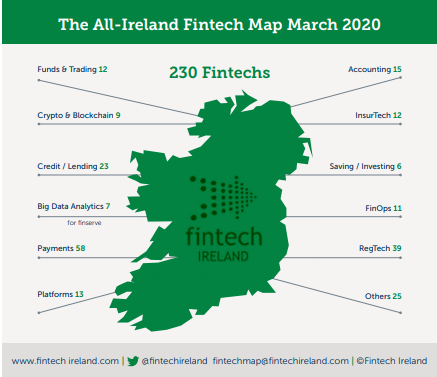 Another disruptor in this area is cryptocurrency. Cryptocurrency service providers remit crypto currency11, instead of fiat currency[12], and do so on distributed ledger technology – the most commonly known example being blockchain – which is simply a different set of payment rails than that used by the banks for money movement, such as SWIFT, the UK’s Faster Payments and Europe’s SEPA. Proponents of cryptocurrency for money transfers argue that it is 250 times cheaper on average to use cryptocurrency than traditional banks and is also cheaper than using many fintech apps.
There are less than ten indigenous crypto/blockchain fintech companies operating in Ireland. In recent years they have been joined by about half a dozen large international crypto/ blockchain firms focussed on financial services. Collectively these international companies are valued in the tens of billions of dollars. Like the indigenous companies, these international fintech’s have chosen Ireland to access our highly skilled software engineers, software developers, coders, programmers and data scientists. Noting the Irish government’s support of both blockchain and international financial services, we should expect to see a lot more from this nascent and promising industry in Ireland. Ireland is already perceived as a top global fintech ecosystem. Our challenge is not about reaching the number one spot globally, which simply will not be the case for a small open economy regardless of how progressive we are. Our challenge is to incrementally raise our profile and position year on year and more importantly remain in the upper echelons vis-à-vis our European Union peers. Ireland is home to 10,000+ regulated financial services companies, it is the 4th largest exporter of financial services in the European Union, 250 of the world’s largest financial services institutions have a base here including half of the world’s top 50 banks. With more than 45,000 people employed directly in international financial services, 15% of which work in fintech, is it any wonder that Dublin ranks 5th highest amongst the top 50 European cities according to Findexable Global Fintech Index 2020 and 7th highest ranked EU member state on the OECD’s Ease of Doing Business Index 2019. The future looks bright for Irish fintech. Many of these companies work in regulated markets and a number of these companies are authorised by the Central Bank of Ireland. What they have in common is the need for capital, people and a stable political environment. Ireland benefits from being a member of the European Union. It is an English first speaking language country, enjoys a common law legal system and adheres to the International Financial Reporting Standards. Ireland’s accountancy profession has a lot to offer and gain from Ireland’s fintech ecosystem. Whether it is a young fintech start-up requiring business and financial advice, seed funding, interim CFO services or larger fintech operator with important financial, taxation and HR strategic planning needs, a competent accounting professional is not only the corner stone but indeed the foundation of a successful and sustainable fintech. Footnotes from above section - 11 Examples of two cryptocurrencies include bitcoin and ethereum 12 Fiat currency is legal tender backed by a government, such as USD, EURO and GBP
0 Comments
Back to Blog
Bank of Lithuania's guidelines, opinion and position on security tokens, virtual assets and ICOs3/6/2020  Our blog of yesterday (02/06/2020) which was highlighted by Peter Oakes in his Linkedin account yesterday was been viewed 3,500+ times in less than a day*. Thanks for your interest in the topic of "Lithuanian Central Bank gives banks guidelines on opening accounts for electronic money and payment institutions."
By the way, for those interested in #tokens, #virtualassets and initial coin offerings (#ICOs), Lietuvos bankas / Bank of Lithuania has released a number of relevant documents in this space, worthy of a read, including:
If a problem with the above links, try to access via https://www.lb.lt/en/bank-of-lithuania-positions-and-guidelines See Linkedin Post at https://www.linkedin.com/posts/peteroakes_lithuania-electronicmoney-paymentinstitutions-activity-6673647923059798016-CBqg
Back to Blog
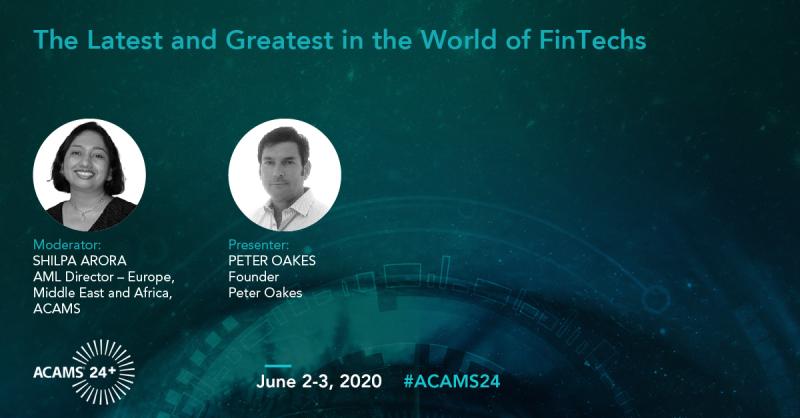 CompliReg's Peter Oakes joins Shilpa Arora, AML Director - Europe, Middle-East and Africa at ACAMS 24+ Financial Crime Marathon (2 & 3 June 2020) to discuss The Latest and Greatest in the World of Fintech.
Click here to watch the video
Back to Blog
 The Bank of Lithuania (the Lithuanian central bank) (BoL) has issued its position paper on the right of electronic money institutions (EMIs) and payment institutions (PIs) to access bank accounts. You can download the position paper here.
Releasing the position paper, Jekaterina Govina, Director of the Supervision Service of the BoL said: “We hope that this position, agreed on with all market participants, will provide more clarity and help fintechs operate more smoothly as well as allow banks to improve their cooperation with such companies, while maintaining high risk management standards". Whilst the position paper is not an official interpretation of legislation, it is issued to support the right of institutions to access bank accounts opened with credit institutions and being necessary for their activities as stipulated in Article 10 of the Republic of Lithuania Law on Payments. Thus although the institutions have the right to apply to a credit institution for, for example, the opening of a payment account, there is no legal obligation on a credit institution to open said account for the institution. The position paper seeks to draw the attention of banks operating in Lithuania to the fact that some of their decisions regarding rejection to open accounts and/or unilaterally closing them, and/or applying restrictions on their access may cause negative consequences for EMIs/PIs and limit their licensed activities. The BoL notes that such decisions are often based on banks’ goal to properly manage the risk of money laundering and/or terrorist financing. The position paper doesn't seek to supplant banks' risk based decisions about which EMIs/PIs that they are prepared to give accounts to and to keep operating. This is rightly understandable especially noting that some banks may be concerned that the regulator has recently fined Lithuanian EMIs/PIs for various failures, including money laundering compliance. If you are a bank and you are processing payments for an EMI/PI, providing safeguarding for the EMI's/PI's clients and/or holding the EMI's/PI's ' corporate money and you have valid concerns about their compliance, you might ask yourself would it be wise to service this industry? Recent examples of fines against EMIs/PIs include:
Anyway, getting back to the position paper, it aims to ensure that while banks manage their own risks, banks do not violate the right of EMIs/PIs to have accounts with credit institutions and to access them. The specific type of accounts referenced in the position paper are:
A question we have, and we are sure many bank executives will be vexed by is: "How does a bank reconcile not only the desire of the BoL but at the same time protect its reputation, its shareholders and most importantly the financial system from financial crime?" An obvious starting point is to avoid the mindset that despite a particular financial sector being considered risker, it is OK to apply a carte blanche policy of refusing to provide players within that sector an account (or terminate their account). As the BoL puts it "banks must comply with the principles of objectivity, non-discrimination and proportionality in respect to EMIs/PIs, i.e. to ensure that their decisions and other actions relating to the opening (or closing) of accounts are impartial and objective". Or in other words (actually the words of the BoL) banks should ensure that:
are applied only after having assessed the circumstances relevant in a specific case and only when it is impossible to apply other risk management and mitigation measures. Yet we wonder, noting that the Lithuanian National Risk Assessment for Money Laundering and Terrorist Financing (released 28 May 2020) (LNRA) places payments/electronic money in the third highest category (of eight categories) for money laundering and terrorist financing threat and vulnerability, how quickly banks will not only adopt the BoL position paper but demonstrably work towards achieving the desired outcome? You can download the LNRA here. The position paper will no doubt be warmly welcomed by the 71 Electronic Money Institutions and 45 Payment Institutions which operate in Lithuania as at 25 May 2020. According to the Bank of Lithuania, the country ranks first in continental Europe in terms of licensed EMIs. This blog written by Peter Oakes. Peter advises on Lithuanian EMI/PI issues and advised on the authorisation of one Lithuania's first special bank authorisations. If you require a licence to operate in Lithuania, Ireland, Cyprus, Malta or the UK, see our Authorisation Page. We have a great network of experts in each country too, from lawyers, to accountants to technical experts. And get in contact if you have a question about this blog.
Back to Blog
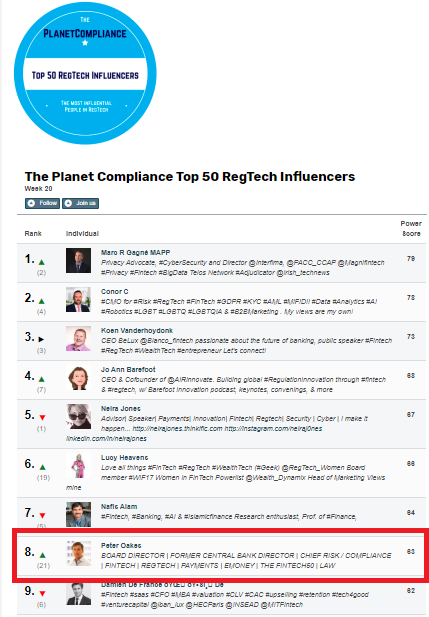 Yet again, our Peter Oakes, Non-Executive Director FinTech & FinServ and Founder of CompliReg and Fintech Ireland ranked in Top 10 of of the Top 50 RegTech Influencers. Planet Compliance updates a list of people that it finds are the key influencers in the field of RegTech. You'll find Peter Oakes featured almost every week in this list of RegTech influencers.
Peter was identified by the prestigious Chambers & Partners in January 2020 as leading band 1 FinTech advisor too.
Back to Blog
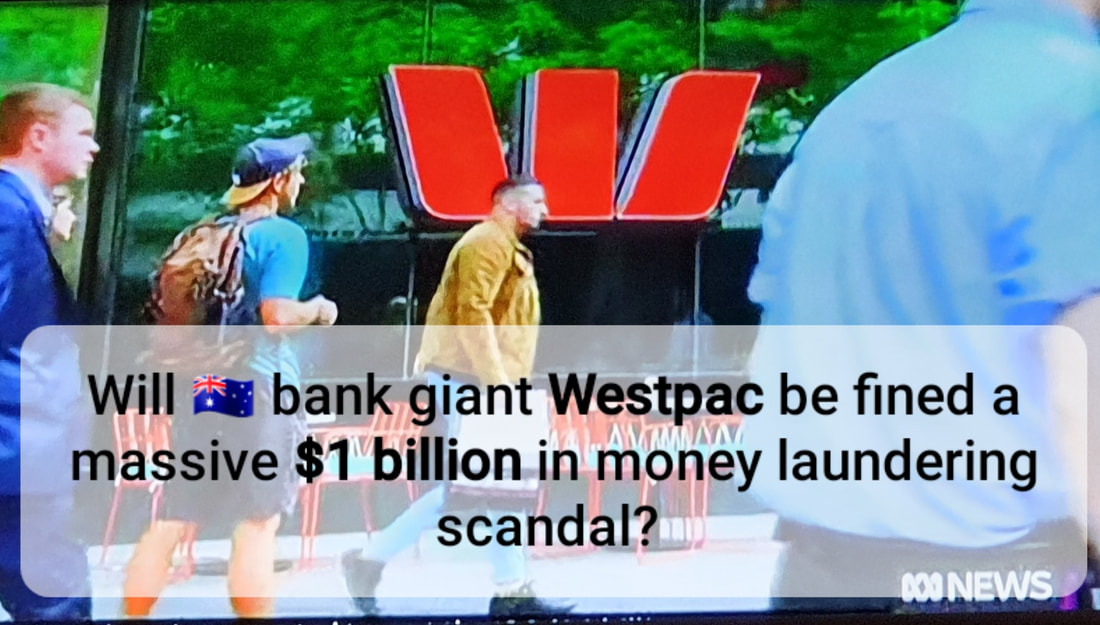 Australian Bank giant Westpac is expecting to fork out more than $1 billion as a result of its money laundering scandal and admitting to 23 million anti-money laundering breaches.
It's not just story about culture, conduct risk and financial crime risks. Far more importantly, it is a story of shame, leadership failure and financial pain for Westpac and relief for another Aussie bank. The fine would be the biggest corporate fine in Australian history. Westpac has revealed it expects the ongoing AUSTRAC investigation will cost it $1.03 billion. Such a fine will represent about 15% of the bank's 2019 profit. Shame: In November last year AUSTRAC, the entity responsible for preventing financial crimes, said the bank had violated anti-money laundering and counter-terrorism laws more than 23 million times (which the bank admits), allowing money tied to child exploitation in south-east Asia to flow freely. For example, Westpac's system was used by paedophiles to send money to the Philippines to pay for child abuse material without raising any red flags. Notwithstanding Westpac's admission, the bank is not going down without a fight. In the 57-page defence document filed with the court, Westpac denied AUSTRAC'S accusation that it failed to identify activity indicative of child exploitation risks. Leadership Failure: The scandal brought down Westpac's leadership, forcing the resignation of chief executive Brian Hartzer and the early retirement of chairman Lindsay Maxsted. Financial Pain: Last year Australian financial press reported that a penalty or settlement of $2 billion or $3 billion would see its CET1 ratio falling below 10.5% meaning the bank would be forced into another equity raising. And the trouble doesn't stop there for Westpac as the corporate regulator, ASIC, is probing into Westpac's previous $2.5 billion equity raise. Relief: Commonwealth Bank will be delighted to pass the mantle of the indignity of Australia's current money laundering record fine of $700 million to Westpac (Commonwealth Bank was fined for systemically failing to report around 54,000 suspicious transactions made through its "intelligent deposit machines"). If you want more on the story from the media, there are updates on an almost weekly basis - soon I guess daily basis. Just use this link to keep track of the story: "Westpac Austrac money laundering fine". And add case to your case studies and typologies in your AML / CTF training for everything from CDD, transaction monitoring, risk assessment, culture, condusct risk and (lack of) crisis management. Peter Oakes, Founder, CompliReg Peter Oakes is an experience anti-financial crime, fintech and board director professional. He served as Ireland's first Director of Enforcement and Financial Crime Supervision at the Central Bank of Ireland (2010-2013) in the aftermath of the financial crisis, leading the investigation and enforcement efforts into the Irish banking industry. Peter is a regular contributor to, and moderator and panel member at, ACAMS events.
Back to Blog
 European Supervisors Instructed to Challenge Banks More Frequently. Peter Oakes discusses this topic with Gabriel Vedrenne, ACAMS MoneyLaundering.com
CLICK HERE
Back to Blog
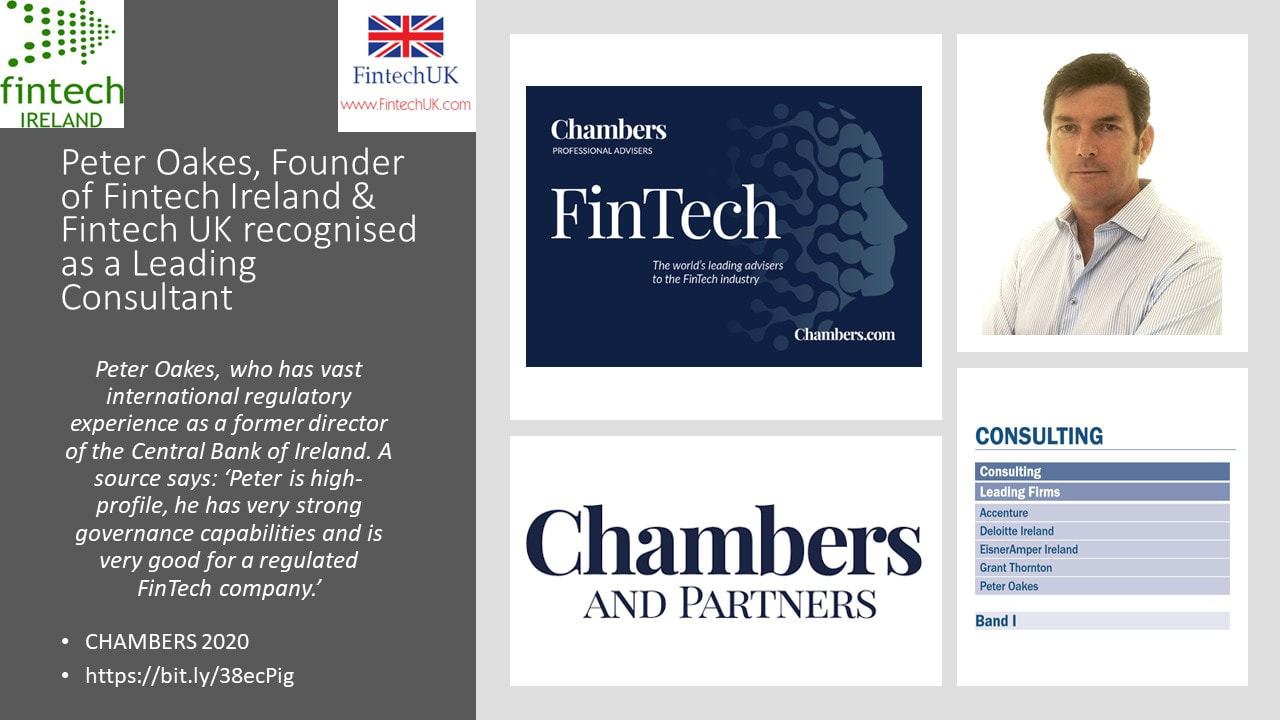 16 January 2020: Peter Oakes, Founder of CompliReg (and Founder of Fintech Ireland, Fintech UK, Fintech NI and US Fintech / USTechFin) has been recognised as a Leading Band 1 Consultant in Chambers & Partners’ 2020 Professional Advisers guide for FinTech – the premier ranking of professional advisers to the financial services industry.
Peter secured a nationwide Ireland Band 1 ranking – Chambers’ top-tier ranking – where it was noted that: Peter Oakes, who has vast international regulatory experience as a former director of the Central Bank of Ireland. A source says: ‘Peter is high-profile, he has very strong governance capabilities and is very good for a regulated FinTech company.' Peter is a non-executive director of regulated fintech companies in the payments, e-money and MiFID sectors and is an adviser and mentor to fintech and regtech startups and scaleups. In Ireland he is a consultant to Clark Hill and in the UK he is a consultant to Kerman & Co, which is supporting the Fintech UK project. Learn more about Peter Oakes’s rankings in the Chambers FinTech guide here: https://chambers.com/department/peter-oakes-consulting-fintech-49:2743:114:1:23173986
Back to Blog
EU inches towards uniform AML rules and supervision. Peter Oakes discusses this topic with Gabriel Vedrenne, ACAMS MoneyLaundering.com
CLICK HERE
Back to Blog
 If the United Kingdom's planned exit from the EU has complicated the lives of bankers, perhaps they can enjoy a little schadenfreude at the expense of the frequent bogeyman of their profession: bank regulators, who must now supervise the partial or wholesale relocation of scores of financial institutions from Great Britain to the bloc.
Peter Oakes discusses this topic with Gabriel Vedrenne, ACAMS MoneyLaundering.com CLICK HERE |

© CompliReg.com Dublin 2, Ireland ph +353 1 639 2971
| www.complireg.com | officeATcomplireg.com [replace AT with @]
| www.complireg.com | officeATcomplireg.com [replace AT with @]
